

Laser Welding Machine Market to Reach USD 5.77 Billion by 2035 at 7.5% CAGR
Laser welding machine Market1
The global Laser Welding Machine Market was valued at USD 2.80 billion in 2025 and is projected to grow from USD 3.01 billion in 2026
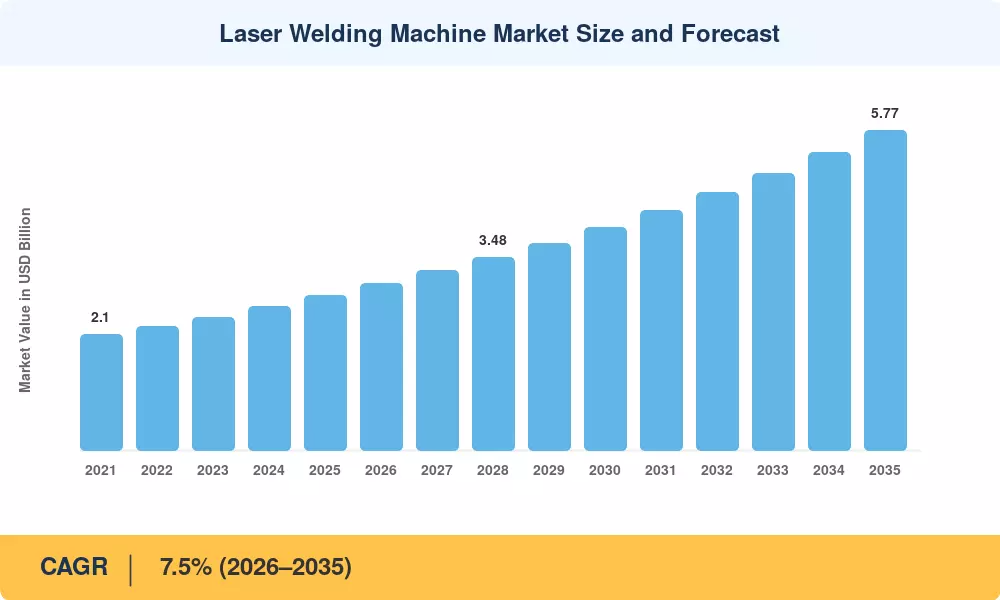
The global Laser Welding Machine Market was valued at USD 2.80 billion in 2025 and is projected to grow from USD 3.01 billion in 2026 to USD 5.77 billion by 2035”
NEW YORK, NY, UNITED STATES, July 27, 2026 /EINPresswire.com/ -- The global Laser Welding Machine Market was valued at USD 2.80 billion in 2025 and is projected to grow from USD 3.01 billion in 2026 to USD 5.77 billion by 2035, registering a CAGR of 7.5% during 2026–2035.— Arti Dhapte
Market Overview
Laser welding machines are advanced joining systems that use a highly concentrated, coherent beam of light to fuse materials—typically metals and certain thermoplastics—with exceptional precision and minimal heat input . Unlike conventional arc welding processes, laser welding delivers a high power density in a small focal spot, enabling deep penetration welds with narrow heat-affected zones, minimal distortion, and superior weld quality . These machines encompass a variety of laser sources, including fiber lasers, CO₂ lasers, Nd:YAG lasers, and diode lasers, configured across fully automated robotic cells, semi-automatic workstations, and manual handheld units .
The market's robust growth trajectory is driven by several powerful catalysts. The accelerating shift toward lightweight materials in automotive manufacturing—driven by emissions targets under the EU's Euro 7 standards and the U.S. EPA's Multi-Pollutant Emissions Standards—is a primary driver . The electronics industry's relentless push toward miniaturized, hermetically sealed components that only non-contact joining can reliably produce further accelerates demand . Legacy resistance welding and TIG welding setups are yielding ground to fiber and diode laser platforms that deliver higher beam quality, lower per-watt costs, and dramatically smaller heat-affected zones . The automotive sector alone is channeling an estimated USD 12 billion globally into body-in-white laser joining lines through 2030, according to the International Energy Agency's EV industrial readiness reports . Battery module assembly for electric vehicles has emerged as a particularly high-growth niche, where weld consistency directly affects cell safety and cycle life.
Industry trends indicate a decisive shift toward smart, connected, and automated laser welding solutions. Real-time weld-quality monitoring via inline optical coherence tomography (OCT) sensors, AI-driven parameter optimization, and digital-twin process simulation are transforming laser welding from a standalone operation into an integrated data node within smart factories . Platform consolidation and modular laser cells are gaining traction, with vendors shifting from monolithic machine sales to configurable platform architectures where beam sources, optics modules, and automation packages can be mixed and matched .
Technological developments are rapidly expanding the market's reach and performance capabilities. The fast price decline of GaN-based blue diode lasers (35% since 2022) provides a clear route to efficient copper and precious-metal welding, unlocking applications in motor winding, power electronics, and battery interconnects . Modular laser cells with lower entry prices for smaller fabricators are emerging, with IPG Photonics and Coherent launching modular-cell product lines since 2024 . Directed energy deposition systems that combine laser cladding with subtractive machining represent a frontier, with the U.S. Department of Energy investing USD 60 million in hybrid manufacturing R&D .
Policy and regulatory influence on the market is substantial. Corporate ESG mandates increasingly require suppliers to demonstrate lower energy consumption and reduced material waste in manufacturing processes . As Scope 3 emissions reporting becomes mandatory under the EU Corporate Sustainability Reporting Directive, OEMs will preferentially specify laser joining . Stringent laser-safety regulations, including IEC 60825 and Machinery Regulation 2023/1230, require compliance and CE marking before installation . Medical device regulatory tightening under the EU MDR is driving demand for precision laser welding in implantable device manufacturing .
The demand outlook remains exceptionally strong, with the market poised for sustained double-digit growth in select verticals. Asia-Pacific commands roughly 38% of the market, propelled by China's dominance in EV production and consumer electronics assembly . The region also registers the fastest CAGR at 8.8% through 2035. Europe holds the second-largest share at 28%, underpinned by Germany's advanced automotive OEMs and Tier-1 suppliers . North America contributes 24%, with aerospace and medical device manufacturing driving demand .
📍 Get Free Sample Report for Detailed Market Insights:
https://www.marketresearchfuture.com/sample_request/4240
Market Segmentation
By Laser Type
The laser welding machine market is segmented by laser type into Fiber Laser, CO₂ Laser, Nd:YAG Laser, Diode Laser, and Others (Disk, Green, Blue) . Fiber laser systems account for approximately 44% of the market, owing to superior wall-plug efficiency (above 45%), maintenance simplicity, and versatility across a broad power range from 200 W micro-welding to 20 kW deep-penetration applications . Diode laser welding platforms are growing at a CAGR of 9.2%, the fastest among technology types, particularly in automotive brazing of roof seams and zinc-coated steel lap joints where their rectangular beam profile creates wider, more cosmetically appealing seams . CO₂ laser machines still hold USD 0.39 billion in annual revenue, concentrated in thick-section industrial cutting and joining . Nd:YAG lasers grow at 5.8% CAGR, serving legacy precision applications and pulsed micro-welding .
By Application
Application segmentation covers Automotive & Transportation, Electronics & Semiconductors, Medical Devices, Aerospace & Defense, Energy, and Others (Jewelry, Tooling, General Fabrication) . Automotive and transportation represent roughly 32% of global demand, driven by EV battery assembly (300–500 welds per pack), body-in-white lightweighting, and powertrain components . Electronics and semiconductor packaging are projected to reach a CAGR of 8.6%, propelled by advanced packaging architectures such as chiplets, fan-out wafer-level packaging, and 2.5D/3D stacking requiring sub-100-micron hermetic sealing . Medical device manufacturing contributes USD 0.34 billion, driven by Class III implantable device regulations under the EU MDR . Aerospace and defense grow at 7.8% CAGR, driven by engine components, fuselage panels, and defense systems .
By Operation Mode
Operation mode segmentation includes Fully Automatic (Robotic), Semi-Automatic, and Manual / Handheld . Fully automatic robotic cells dominate by volume at 56% market share, concentrated in high-volume OEM production lines where cycle-time consistency justifies higher capital investment . Semi-automatic platforms are the fastest-growing mode at 8.1% CAGR, serving job shops and flexible batch production . Manual/handheld systems represent USD 0.31 billion in 2025, with portable units priced between USD 5,000 and USD 25,000 democratizing access for small fabricators and field-service technicians .
By Region
Regional segmentation includes North America, Europe, Asia Pacific, South America, and the Middle East and Africa. Asia-Pacific leads with 38% revenue share, anchored by China, Japan, and South Korea . Europe holds the second-largest share at 28%, benefiting from a CAGR of 7.1% led by Germany and France . North America contributes 24% with USD 0.67 billion in 2025 . South America grows at 6.2% CAGR, driven by automotive parts and energy infrastructure . The Middle East and Africa represent the smallest region at roughly 5% share but show rising adoption in energy sector fabrication .
🛒 You can buy this market report at:
https://www.marketresearchfuture.com/checkout?currency=one_user-USD&report_id=4240
Regional Analysis
Asia-Pacific
Asia-Pacific commands roughly 38% of the global laser welding machine market and registers the fastest CAGR at 8.8% through 2035 . China accounts for 52% of regional share, driven by its position as the world's largest producer of EVs, consumer electronics, and photovoltaic modules, with CATL's six domestic gigafactories and BYD's vertically integrated production complexes consuming several hundred laser welding cells annually . Japan contributes USD 0.14 billion, with strength in ultra-precision systems for semiconductor and automotive powertrain components . South Korea grows at 8.4% CAGR, driven by display panel and battery cell production . India is the fastest-growing major market at 10.1% CAGR, fueled by its Production-Linked Incentive scheme allocating USD 2.5 billion to electronics and automotive component manufacturing . Southeast Asian countries attract significant FDI in EV component and consumer electronics assembly .
Europe
Europe holds the second-largest share at 28% of the market, benefitting from a CAGR of 7.1% . Germany leads regional demand at 36% of European share, driven by its dense network of automotive OEMs—Volkswagen, BMW, Mercedes-Benz—and Tier-1 suppliers, along with the Fraunhofer ILT institute setting global standards in laser process research . France grows at 7.3% CAGR, driven by Airbus's transition to laser-welded fuselage panels and nuclear applications . The United Kingdom contributes USD 0.07 billion, supported by medical device and defense manufacturing . Eastern European plants serve as cost-competitive production hubs for laser-joined automotive subassemblies .
North America
North America contributes 24% of the global market with USD 0.67 billion in 2025 . The United States accounts for 78% of regional share, anchored by its aerospace-defense industrial base and the recent wave of EV battery plant construction, with the DOE Loan Programs Office facilitating over USD 40 billion in clean-energy manufacturing loans since 2022 . Canada grows at 7.0% CAGR, benefitting from cross-border automotive supply chains . Mexico contributes USD 0.04 billion, with nearshoring trends drawing laser equipment into newly established maquiladora plants .
Rest of the World
The Rest of the World segment, encompassing South America, the Middle East, and Africa, presents developing market opportunities. Brazil dominates South American demand with 62% of regional share, supported by Stellantis, Volkswagen, and Toyota assembly plants progressively integrating laser joining . Argentina grows at 6.5% CAGR, driven by energy sector fabrication and its nascent lithium-battery value chain . The UAE represents 30% of Middle East and Africa regional share, driven by industrial diversification under Abu Dhabi Vision 2030 . Saudi Arabia grows at 7.8% CAGR, supported by NEOM and defense localization . Across Sub-Saharan Africa, adoption remains nascent but is rising in mining-equipment fabrication and power-generation infrastructure .
Competitive Landscape / Key Players
The laser welding machine market exhibits moderate concentration, with the top five players commanding a combined 40–48% revenue share . Key companies operating in this market include Trumpf GmbH, IPG Photonics, Coherent Corp., FANUC Corporation, Panasonic Connect, Amada Holdings, Han's Laser Technology, Jenoptik AG, Laserline GmbH, and EMAG Group .
Strategic developments in the market include significant acquisitions and product launches. In February 2025, Trumpf Group purchased EHRT Maschinenbau, adding ultrasonic capability for hybrid aluminum-to-copper battery tabs . In May 2024, IPG Photonics introduced LightWELD XR, a next-generation handheld unit with 2.5 kW output and wobble-weld functionality, expanding the addressable market for field repair and small-batch production . Coherent Corp announced in January 2025 an investment of USD 50 million to increase multi-kilowatt laser production at its Saxonburg facility by 2026 .
Competitive differentiation increasingly hinges on vertical integration, software ecosystem depth, and modular platform strategies. Trumpf maintains a full-stack laser source and system integrator position . IPG Photonics leads upstream fiber-laser source supply . FANUC leverages its robotics ecosystem . Han's Laser Technology dominates with cost leadership in the Chinese domestic market .
Latest Industry News & Developments
Recent industry developments highlight the ongoing transformation of the laser welding machine market toward greater efficiency, connectivity, and application expansion. In February 2025, Trumpf Group purchased EHRT Maschinenbau, adding ultrasonic capability for hybrid aluminum-to-copper battery tabs, addressing a critical challenge in EV battery assembly where dissimilar material joining is essential . This acquisition reflects the trend of integration to meet complex manufacturing requirements.
In May 2024, IPG Photonics introduced LightWELD XR, a next-generation handheld unit with 2.5 kW output and wobble-weld functionality, expanding the addressable market for field repair and small-batch production . The product launch addresses the growing demand for portable, cost-effective laser welding solutions outside traditional factory settings, democratizing access for small fabricators and maintenance operations.
Coherent Corp announced in January 2025 an investment of USD 50 million to increase multi-kilowatt laser production at its Saxonburg facility by 2026, responding to surging demand from EV battery and aerospace applications . This capacity expansion reflects the industry's response to the accelerating electrification supercycle and the need for reliable supply chains for high-power laser components.
Market Challenges & Opportunities
Key restraints facing the laser welding machine market include the high upfront capital cost compared to conventional welding, with a fully equipped fiber laser welding cell costing USD 250,000–800,000 compared with USD 40,000–100,000 for an equivalent resistance or MIG welding station . Skilled-operator and laser-safety training gaps represent a significant constraint, with the American Welding Society projecting a shortage of 360,000 skilled welding professionals in the U.S. by 2027 . Reflective-material processing limitations, particularly for copper and aluminum with near-infrared fiber lasers, remain a technology ceiling, though green and blue laser sources are emerging .
Emerging opportunities in the market are substantial and diverse. Green and blue laser commercialization presents a significant opportunity, with multi-kilowatt blue-laser technologies potentially unlocking an estimated USD 400 million incremental addressable market by 2030 in motor winding, power electronics, and battery interconnects . Machine-as-a-service and pay-per-weld models are addressing the capital intensity barrier, particularly in SME-heavy economies, by offering outcome-based pricing linked to weld counts or uptime guarantees . Emerging-market industrialization, particularly India's Production-Linked Incentive scheme and ASEAN's FDI in electronics assembly, presents a greenfield opportunity for compact, cost-optimized systems .
Future potential lies in additive-hybrid manufacturing platforms that combine laser cladding with subtractive machining, enabling higher-margin, longer-cycle revenue . AI-driven weld quality assurance, using inline OCT and high-speed camera systems coupled with machine-learning defect classifiers, enables 100% non-destructive inspection at weld speed, accelerating ROI justification . Platform economics and modular laser cells, with configurable architectures lowering entry prices and creating recurring revenue through upgrade paths, will define competitive differentiation through the 2030s .
To explore more market insights, visit us at:
https://www.marketresearchfuture.com/reports/laser-welding-machine-market-4240
Final Market Summary
The laser welding machine market is positioned for robust growth through 2035, driven by EV battery assembly, automotive lightweighting mandates, electronics miniaturization, and smart factory integration. The projected valuation of USD 5.77 billion reflects rapidly expanding adoption across automotive, electronics, medical devices, and aerospace sectors, with the market transitioning from conventional arc welding to precision, non-contact laser joining.
The medium-term growth outlook remains strong, with the market registering a CAGR of 7.5% during the forecast period. Asia-Pacific will continue to lead market expansion through China's EV and electronics dominance and India's industrialization, while Europe and North America maintain significant positions through automotive technology leadership and aerospace-medical applications.
Long-term industry potential extends beyond the current forecast horizon. The electrification supercycle and evolution from liquid-electrolyte to solid-state batteries between 2028 and 2032 will reshape laser welding requirements, creating a replacement cycle as existing gigafactories retrofit for new cell chemistries. Platform consolidation and software ecosystems will transition the industry from hardware-centric to software-defined models, with open-API architectures enabling deeper integration with manufacturing execution systems. Sustainability and ESG-driven procurement, with laser welding consuming 50–70% less energy per joint than resistance welding, will reinforce demand as Scope 3 emissions reporting becomes mandatory. Manufacturers that successfully develop modular, AI-integrated solutions, invest in green and blue laser technologies, and establish machine-as-a-service models will capture substantial value in this evolving market. The transformation of welding from manual skill-based to automated, data-driven precision joining represents a fundamental shift in manufacturing capability, enabling the production of lighter, more efficient, and more reliable products across industries.
More Related Reports from MRFR Library:
Us Cutting Tools Market: https://www.marketresearchfuture.com/reports/us-cutting-tools-market-13197
Us Plastic Waste Management Market: https://www.marketresearchfuture.com/reports/us-plastic-waste-management-market-13220
Us Agriculture Equipment Market: https://www.marketresearchfuture.com/reports/us-agriculture-equipment-market-16229
Us Industrial Valve Market: https://www.marketresearchfuture.com/reports/us-industrial-valve-market-16273
Vacuum Valve Market: https://www.marketresearchfuture.com/reports/vacuum-valve-market-17181
Super Precision Bearing Market: https://www.marketresearchfuture.com/reports/super-precision-bearing-market-17769
Us Industrial Dust Collector Market: https://www.marketresearchfuture.com/reports/us-industrial-dust-collector-market-19676
Dropshipping Market: https://www.marketresearchfuture.com/reports/dropshipping-market-20308
Hand Tools Market: https://www.marketresearchfuture.com/reports/hand-tools-market-21328
Waste Management Market: https://www.marketresearchfuture.com/reports/waste-management-market-21342
Larry Wilson
WantStats Research And Media Pvt. Ltd.
+1 855-661-4441
email us here
Legal Disclaimer:
EIN Presswire provides this news content "as is" without warranty of any kind. We do not accept any responsibility or liability for the accuracy, content, images, videos, licenses, completeness, legality, or reliability of the information contained in this article. If you have any complaints or copyright issues related to this article, kindly contact the author above.
